
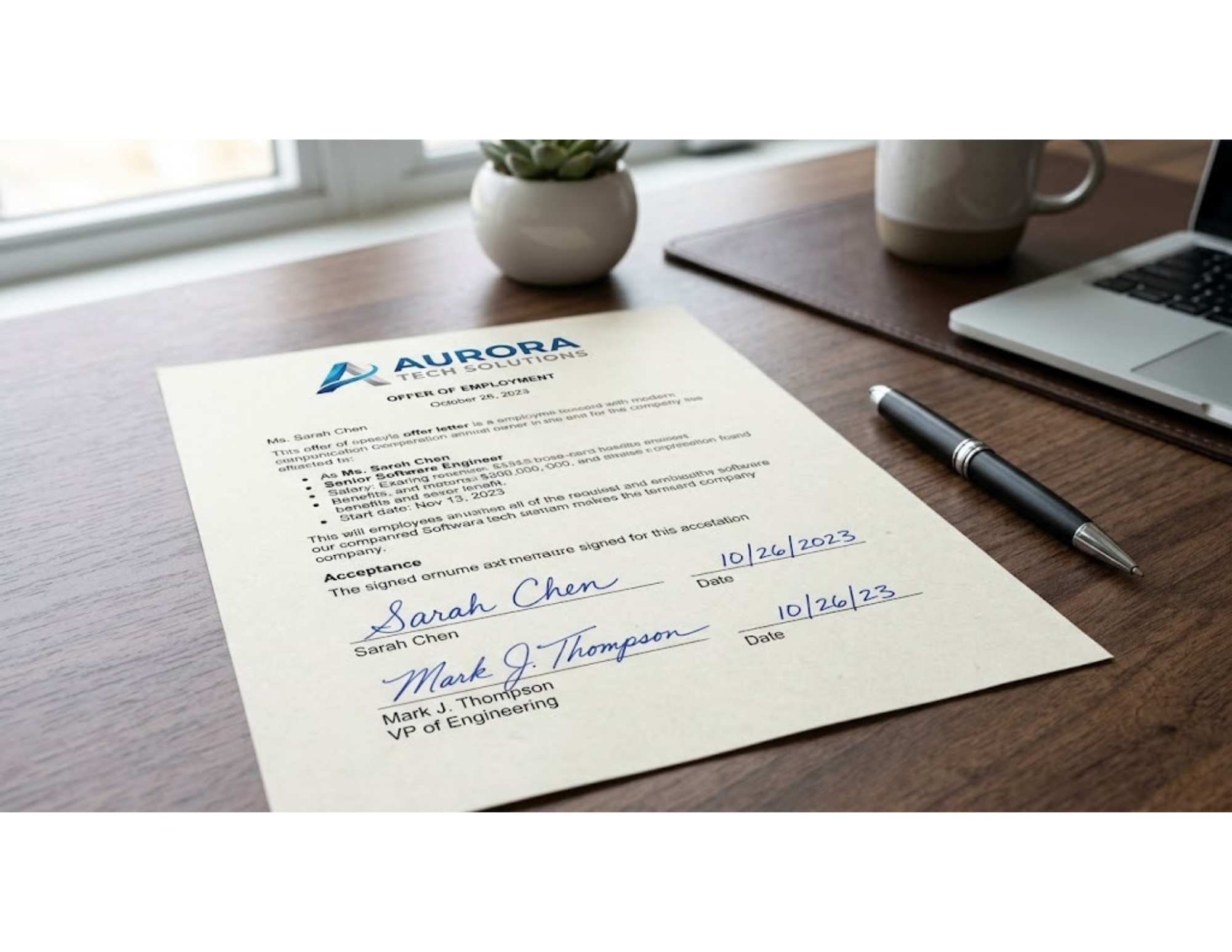
When a U.S. company decides to hire a Mexican engineer through the TN visa process, the employer's role is simpler than most people expect. You don't file a petition with USCIS. You don't wait on a lottery. The main thing you need to get right is the offer letter.
That letter travels with your engineer to the U.S. consulate in Mexico for the visa interview, where a consular officer reviews it. If it is complete, clear, and consistent with an engineering role, the process moves forward. If it is missing a required element or uses vague language, it can delay or derail an application that was otherwise solid.
This guide breaks down every required element, the most common mistakes we see, and what you as an employer need to know before you draft that letter.
What the Offer Letter Actually Does
Unlike an H-1B petition, where the employer files extensive paperwork with USCIS, the TN process does not require employer sponsorship in the traditional sense. You extend a job offer. You write a letter. That letter, combined with the engineer's academic credentials and supporting documents, is what the consulate reviews.
The letter serves two purposes at once. It confirms the employment arrangement for the engineer, and it demonstrates to the reviewing officer that the role is a legitimate professional engineering position qualifying under the TN category. Those two purposes require different things, and a good offer letter satisfies both.
A typical U.S. employment offer letter focuses on compensation, benefits, and start logistics. A TN offer letter does all of that, but it also functions as a document that establishes visa eligibility. The language around job title, duties, and credentials must be precise. This is not the place for vague HR boilerplate.
The 9 Required Elements
The following fields belong in every TN offer letter for an engineering role. Missing or incomplete information on any of these is among the most common reasons applications run into trouble.
Company Letterhead Required
The letter must be on official company letterhead with your full company name, address, phone number, and ideally a contact email. This establishes employer identity and gives the consulate a way to verify the offer if needed.
Candidate's Full Legal Name Required
The name on the offer letter must match the name on the candidate's passport and educational credentials exactly. Even minor discrepancies, such as a middle name included in one document but not another, can create problems at the consulate window.
Job Title Critical
The title must correspond to a TN-eligible engineering profession. Mechanical Engineer, Industrial Engineer, Manufacturing Engineer, Process Engineer, and similar titles are clearly recognized. Titles such as Operations Manager, Plant Supervisor, or Project Lead, used alone without engineering context, may not qualify. When in doubt, include Engineer in the title and make sure the duties support it.
Description of Duties Critical
This is the most important section in the letter. The duties described must read as professional engineering work: analysis, design, troubleshooting, optimization, quality systems, process improvement, technical reporting. Vague language such as supports the team or manages daily operations, without engineering specificity, invites an officer to question whether the role truly qualifies. Three to five bullet points describing actual technical responsibilities is the right approach.
Full-Time Employment Status
State explicitly that the position is full-time. Part-time arrangements are possible under TN but are less straightforward and require additional documentation.
Annual Salary Required
State compensation as an annual figure, not hourly. This signals professional employment clearly to the reviewing officer. Include the currency. You do not need to detail bonus structures or benefits in the offer letter, so keep it focused on base compensation.
Employment Start Date
Include the anticipated start date. This helps the consulate confirm the role is current and active rather than speculative. Since consular appointment availability drives the timeline, build in realistic lead time and ask your immigration attorney how to word a date that may shift.
Location of Employment
Include the city and state where the engineer will be working. If the role involves multiple sites, list the primary location. Remote-only arrangements are more complex under TN and should be discussed with your immigration attorney.
Authorized Signature Required
The letter must be signed by someone with authority to hire, typically an HR Director, VP of Operations, Plant Manager, or C-level executive. Include the signatory's printed name, title, and direct contact information. An unsigned letter, or one signed by someone whose authority is unclear, raises questions.
What You Do Not Need to Provide
Part of what makes the TN process genuinely different from other visa pathways is what it does not require from you. As the employer, you are not required to:
- File any petition with USCIS
- Obtain a Labor Condition Application, which is an H-1B requirement, not a TN one
- Conduct a prevailing wage determination or prove no U.S. worker was available
- Pay government fees on behalf of the candidate
- Appear at the consular appointment
Your role is the offer letter and a support letter that provides additional context about your company and the position. The support letter is separate from the offer letter and is typically one page confirming who you are, what your company does, and why this engineer is being hired.
The 5 Most Common Mistakes
Job title doesn't match the engineer's degree
A mechanical engineer hired as Operations Supervisor creates a mismatch. The consulate looks for alignment between the degree, the title, and the duties. All three must point to the same profession. When the title drifts toward management or operations without engineering specificity, you risk a denial.
Duties described in non-engineering language
HR boilerplate emphasizing team collaboration, communication skills, and meeting objectives, without describing actual technical work, does not serve the application. Describe what the engineer will do on the plant floor or in the lab: technical analysis, system troubleshooting, process optimization.
Hourly rate instead of annual salary
Listing compensation as an hourly rate rather than an annual figure is a small detail that can read as non-professional employment. Always use annual salary in a TN offer letter.
Missing or unclear signatory
A letter signed with an illegible signature and no printed name creates doubt. If the reviewing officer cannot confirm who signed the letter and whether they have hiring authority, it weakens the application. Print the name, include the title, add a direct phone number.
Using a generic offer letter template
Your standard HR offer letter template was designed for domestic hires. It was not designed to satisfy TN requirements. Using it without adaptation almost always produces a letter missing critical information or using language that does not serve the immigration purpose.
Read your offer letter and ask whether an officer who has never met your candidate and knows nothing about your company could clearly understand that this is a full-time professional engineering role, at a real company, at a specific salary, starting on a specific date. If the answer is anything less than yes, revise before submitting.
What Changed in 2025
Adjudicators now apply closer scrutiny to whether stated duties map precisely to the TN category. Vague or hybrid job descriptions that might have passed a few years ago are being refused. Two consequences follow for employers.
First, the duties section carries more weight than it used to, and generic language is now an active risk rather than a missed opportunity. Second, computer science and software degrees no longer qualify automatically under the engineer category. If you are hiring for a controls or automation role and your candidate holds a CS degree rather than an engineering degree, that case needs review before anyone drafts a letter.
Why Working With an Immigration Attorney Matters Here
The TN process is straightforward relative to other visa pathways, but straightforward does not mean do it without guidance. A qualified immigration attorney reviews your offer letter before it goes anywhere, flags language issues that are not obvious to non-specialists, and makes sure the full documentation package holds together.
At ACE & Bridgewell, offer letter review is built into our process rather than added on. Documentation packages go through Carla Caballero, our immigration attorney, who reviews every file before submission.
A Note on Denials
TN applications can be denied. Beyond offer letter issues, the most common reasons are degree-to-job mismatches, prior immigration complications, and situations where the engineer's ties to Mexico are questioned. None of these are reasons to avoid the process. They are reasons to work with people who screen for these factors before an application reaches the consulate.
Most denials are avoidable when the preparation is thorough. That starts with a clean offer letter and continues through every step of the documentation package.
This article is informational only. ACE & Bridgewell is not an immigration law firm and does not provide legal advice. TN visa requirements can change and individual circumstances vary. Always work with a qualified immigration attorney for guidance specific to your situation.